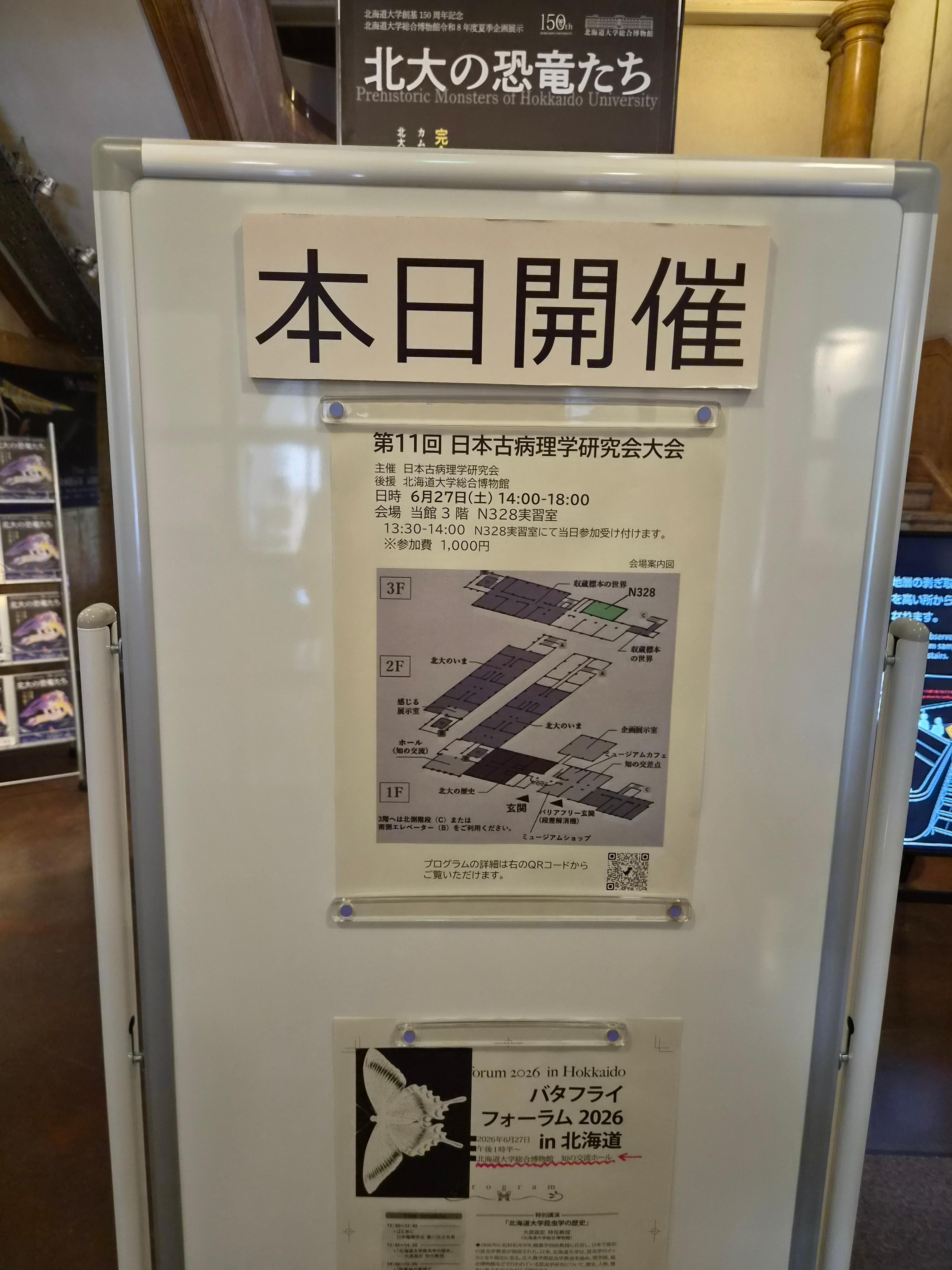
[학회참석] 11회 일본고병리학연구회대회
일본 삿포로시 소재 북해도대 박물관에서 개최된 11회 일본고병리학연구회대회에서
필자의 연구, "A new paleopathological project based on historical documents: Reconstructing health and disease in the Joseon Kingdom through household registers, genealogical records, diaries, and forensic investigation reports" 가 발표되었다.
동 연구는 경희대 홍종하, 고려대 김창영 선생과 공동 연구이다.
초록은 다음과 같다.
A new paleopathological project based on historical documents: Reconstructing health and disease in the Joseon Kingdom through household registers, genealogical records, diaries, and forensic investigation reports
Dong Hoon Shin1, Chang Young Kim2, Jong Ha Hong3
1 Seoul National University, 2 Korea University, 3 Kyung Hee University
Paleopathology seeks to obtain objective evidence regarding the history of diseases that affected our ancestors over long periods of time through the identification and scientific investigation of various health conditions, trauma, and illnesses preserved in human skeletal remains and mummified bodies excavated from archaeological sites. However, although such approaches allow us to understand past phenomena in a highly objective manner, they also possess limitations in terms of specificity when compared with historical research.
For example, in the case of an individual who suffered violence in the past, paleopathological analysis may enable us to estimate the cause of trauma or death, but it cannot reveal precisely how the injuries were inflicted or what kinds of tools or weapons were used. The same limitation applies to food consumption, which played a crucial role in determining the health conditions of people in the past. Although stable isotope analysis and other scientific methods can be used to estimate the types of foods consumed, these approaches provide only broad and generalized answers. More specific information regarding which foods were frequently eaten can only be identified through historical records. Finally, similar limitations apply to demographic studies conducted through skeletal analysis. Although anthropological research can provide valuable insights into past demographic conditions, far more detailed demographic information can be obtained when historical sources such as household registers and census records are available for investigation.
Therefore, we have recently initiated a new project in Korea that examines historical materials from the Joseon Dynasty from a paleopathological perspective, including genealogical records, household registers, diary accounts, and forensic investigation reports and others. In this project, we aim to supplement and strengthen our understanding of demographic patterns, dietary practices, diseases, and traumatic injuries through the integration of firmly documented historical evidence. This work was supported by the Seoul National University Research Grant in 2025 (800-20250466).