WGS restoration of 2000-year-old dogs confirms a distinct lineage of ancient dogs from the Korean Peninsula
A joint research team from the Gaya National Research Institute of Cultural Heritage, the Conservation Science Division of the NRICH, Seokdang Museum of Dong-A University, and the Graduate University for Advanced Studies (SOKENDAI) in Japan has announced that they analyzed the DNA of ancient dogs that lived on the Korean Peninsula and published their findings in the international academic journal PLOS ONE.
This is the first study to analyze the complete genome of ancient Korean dogs.
The team analyzed the remains of four ancient dogs excavated from the Neukdo site in Sacheon and the Bonghwang-dong site in Gimhae. DNA extraction was conducted in a dedicated ancient DNA cleanroom at the Conservation Science Division of the National Research Institute of Cultural Heritage, and the research team succeeded in reconstructing the complete genome of dogs that lived approximately 2,000 years ago using next-generation sequencing (NGS) technology.
* Next-generation sequencing: the latest genomic analysis technology capable of reading large quantities of DNA simultaneously and analyzing the entire genome
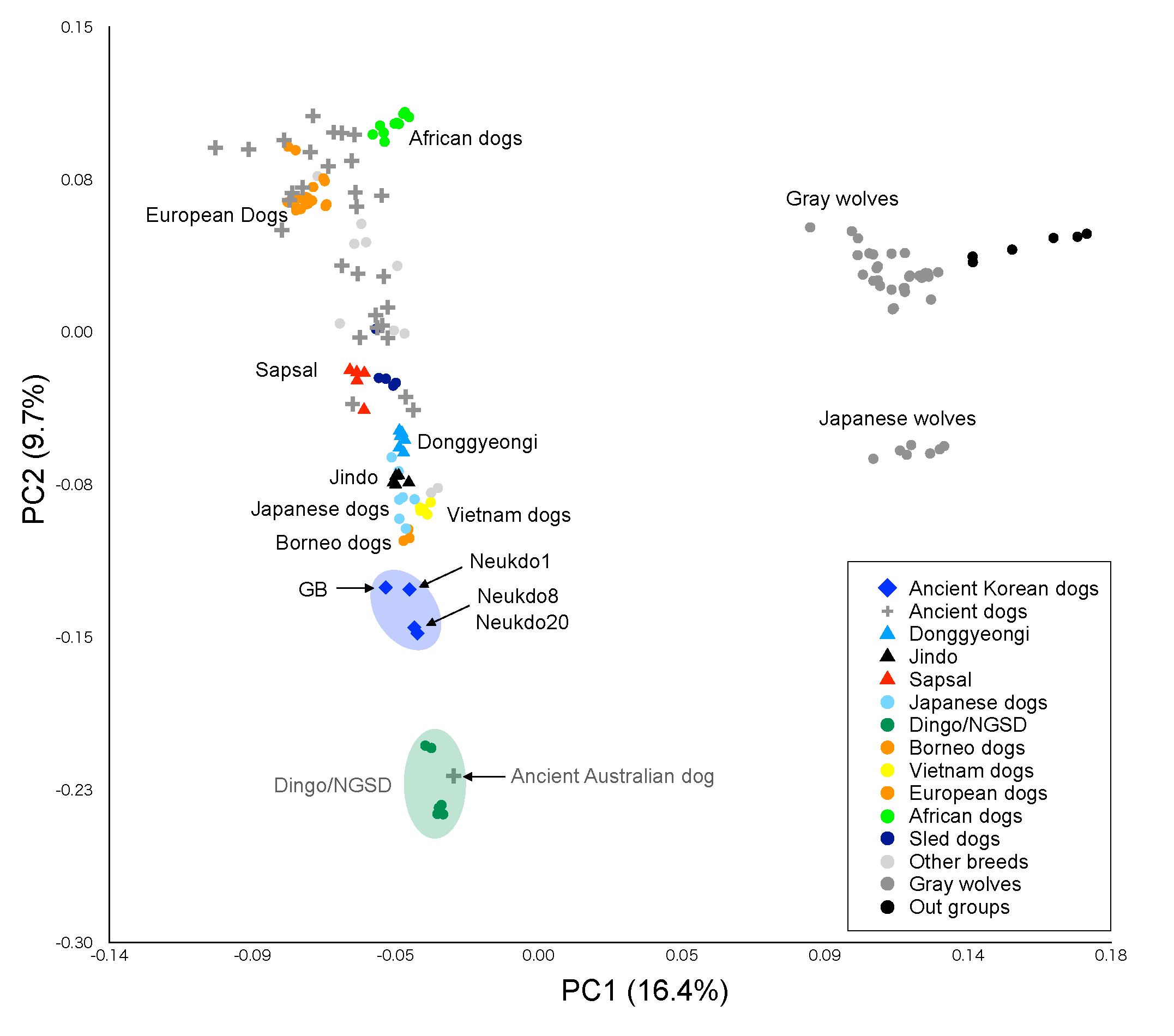
The analysis revealed that ancient dogs from the Korean Peninsula showed characteristics genetically close to those of the Australian dingo* and the New Guinea Singing Dog*, but were not identical to either group.
This confirmed the possibility that ancient Korean dogs had their own distinct lineage.
These findings suggest that East Asian dogs, long assumed to form a single population, were in fact divided into several lineages.
* Dingo: feral dogs inhabiting Australia
* New Guinea Singing Dog: dogs inhabiting the highlands of New Guinea, known for producing a unique, wolf-like howl instead of a traditional bark
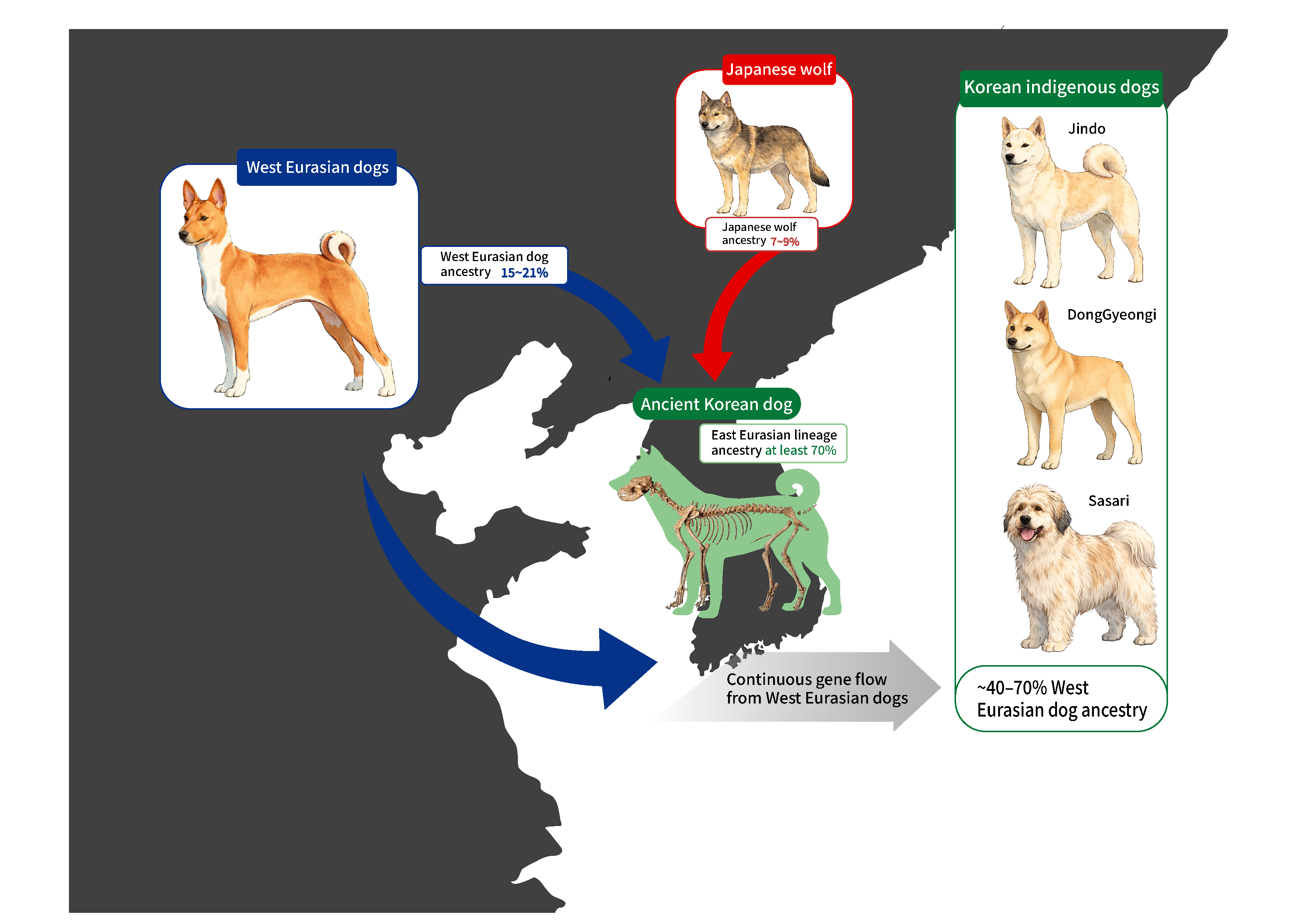
Genes of western origin (from European dogs and others) were also detected in the ancient dogs’ DNA.
This proportion was higher in dogs from later periods than in those from before the Common Era, indicating that genetic exchange between dog populations in Eastern and Western Eurasia had been ongoing for thousands of years.
Currently, native Korean breeds such as the Jindo and Sapsaree are known to carry a higher proportion of Western-lineage genes. This study suggests that this proportion was once low and increased gradually over time.
This implies that the genetic makeup of Korean dogs today is the result of diverse dog populations interbreeding over a long period of time.
The study also found that ancient Korean dogs may have exchanged genes with wolf populations.
In particular, they showed the closest genetic relationship with the Japanese wolf*, with evidence of gene flow also detected with wolf populations in Korea and China.
This demonstrates that dogs and wolves are not entirely separate entities and have continued to influence one another even after domestication.
* Japanese wolf (Canis lupus hodophilax): a wolf subspecies that inhabited Honshu, Kyushu, and Shikoku in Japan, and the smallest known wolf subspecies. It is considered extinct following the confirmation of the last individual in Nara Prefecture in 1905.
The Gaya National Research Institute of Cultural Heritage has established a laboratory for ancient human and animal bones at the Natural Heritage Center in Gimhae and is continuously conducting scientific research on human bones and animal remains across the Gaya cultural sphere.
The ancient dog genome study is one such achievement.
The research team plans to obtain additional Neolithic dog genome data in order to trace the formation and evolution of the dog lineage on the Korean Peninsula back to an even earlier period.
Ancient East Asian dog lineage is revealed by genome of ancient Korean dogs
Hyeongcheol Kim ,Suyeon Kim,A-reum Yu,Eunji Song,Sol Kim,Taiji Miyazaki,Yohey Terai
Published: May 6, 2026
https://doi.org/10.1371/journal.pone.0346864
'NEWS & THESIS' 카테고리의 다른 글
| 중세 시대 턱뼈에서 스코틀랜드 최초 20캐럿 금으로 만든 치아 보철물 발견 (0) | 2026.05.07 |
|---|---|
| 당말에 태어났더래면 이극용과 맞짱 뜨는 절도사였을지 모르는 송강호 (0) | 2026.05.07 |
| 덴마크 북부서 바이킹 시대 황금 팔찌 6점 떼거리로 발굴 (0) | 2026.05.07 |
| 탕구트 서하 왕조에 고급 백자를 관급 납품한 영하宁夏 하란贺兰 소욕구苏峪口 가마들 (0) | 2026.05.07 |
| 남근 미니어처를 부적으로 달고 다닌 로마인들 (0) | 2026.05.07 |


댓글