Nhoem et al. published "A Review of Bioarcheological Investigations in Iron Age Cambodia" in International Journal of Osteoarchaeology https://doi.org/10.1002/oa.70085
Nhoem 외 연구진이 International Journal of Osteoarchaeology에 "캄보디아 철기 시대 생물고고학 연구 검토(A Review of Bioarcheological Investigations in Iron Age Cambodia)"라는 논문을 발표했다(https://doi.org/10.1002/oa.70085).
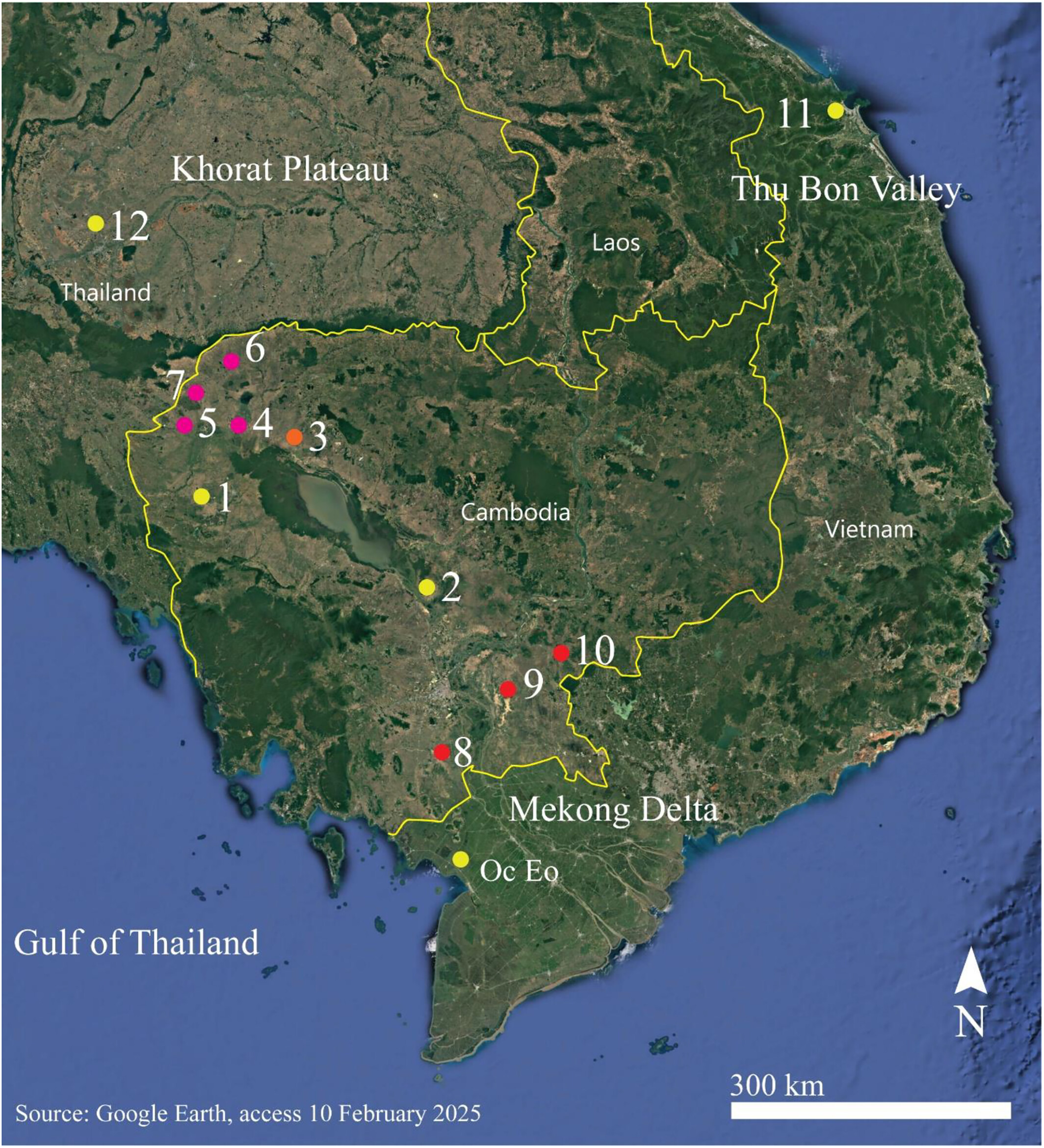
이 논문은 캄보디아의 철기 시대(기원전 500년~기원후 500년) 인골 연구를 검토하고, 발표 및 미발표 자료를 종합하여 앙코르와 북서부 및 남동부 지역(지도 참조)의 유물을 주로 분석한다.
이 연구에는 인구 통계, 신장, 법랑질 형성부전, 치아 건강, 식단, 골격 외상, 이주, 전염병 등에 대한 논의가 포함된다.
인구 통계 자료는 제한적이며, 유해가 파편화했고 인구 통계학적 측정 방법이 부족해 개인의 성별, 사망 연령, 신장을 추정하기 어려운 경우가 많다.
철기 시대 캄보디아 치아 건강은 동남아시아의 이전 시대에 비해 저하된 것으로 보인다.
특히 북서부 지역에서는 생전에 날카로운 흉기나 둔기에 의한 외상, 주로 머리 부위 외상이 매우 흔하게 관찰되었다.
유해 보존 상태가 좋지 않아 병리학적 병변은 드물게 확인되었다.
향후 연구에서는 시간과 장소에 따른 일반적인 양상 간 관계를 더 넓은 맥락에서 이해하는 것이 중요할 것이다.
또한 본 연구는 지역 생물고고학 연구자와 연구 교육의 중요성을 강조한다.
이들은 캄보디아 생물고고학 발전에 핵심적인 역할을 할 연구자들이다.
이하 이 논문 요약과 결론 부분을 적출한다.
ABSTRACT
Archeological research within Cambodia is quite extensive, with significant projects led by both Cambodian archeologists and international researchers alike. Many of these projects have uncovered human skeletal remains. This article reviews archeological human skeletal studies in Cambodia, synthesizing published and unpublished data, primarily from the Iron Age (500 bce–500 ce) across Angkor and the northwest and southeast regions. This synthesis includes discussions of demography, stature and enamel hypoplasia, dental health, diet, skeletal trauma, migration, and infectious diseases. The demographic data are limited, with sex, age at death, and stature often not estimated for individuals because of the fragmentary nature of the remains and the lack of specific population metric methods. Current data show no correlation between stature and enamel hypoplasia. Dental health appears to have declined in Iron Age Cambodia compared to earlier periods across Southeast Asia. A notably high prevalence of perimortem sharp and blunt force trauma, mostly to the head, was observed in the northwest region. Because of the poor preservation of the remains, pathological lesions were infrequently observed. Further bioarcheological research in Cambodia is recommended to enable a full understanding of the health and lifestyle of past populations. Understanding the relationship between general patterns across time and place in a broader context will be important in the next stage of research. This review also highlights the importance of local bioarcheological researchers and research education—these are the researchers who will be crucial to developing bioarcheology in Cambodia.
요약
캄보디아에서는 고고학 연구가 상당히 활발하게 진행되고 있으며, 캄보디아 고고학자들과 국제 연구자들이 주도하는 중요한 프로젝트들이 다수 수행되고 있다. 이러한 프로젝트 상당수에서 인골 유적이 발굴되었다.
본 논문은 캄보디아 인골 연구를 검토하고, 주로 앙코르와 북서부 및 남동부 지역 철기 시대(기원전 500년~기원후 500년) 유물을 중심으로 발표 및 미발표 자료를 종합적으로 분석한다.
이 종합 분석에는 인구 통계, 신장 및 법랑질 형성부전, 치아 건강, 식단, 골격 외상, 이주, 그리고 전염병에 대한 논의가 포함된다.
인구 통계 자료는 제한적이며, 유물의 파편적인 특성과 인구 통계학적 측정 방법의 부재로 인해 개인의 성별, 사망 연령, 신장을 추정하기 어려운 경우가 많다.
현재까지의 자료는 신장과 법랑질 형성부전 사이에 상관관계가 없음을 보여준다.
철기 시대 캄보디아 치아 건강은 동남아시아의 이전 시대에 비해 저하된 것으로 보인다. 특히 북서부 지역에서는 생전에 날카로운 흉기나 둔기에 의한 외상, 주로 머리 부위의 외상이 매우 흔하게 관찰되었다.
유골 보존 상태가 좋지 않아 병리학적 병변은 드물게 관찰되었다. 과거 인구의 건강과 생활 방식을 온전히 이해하기 위해서는 캄보디아에서 더 심도 있는 생물고고학 연구가 필요하다.
시간과 장소에 따른 일반적인 패턴 간 관계를 더 넓은 맥락에서 이해하는 것이 향후 연구에 중요한 역할을 할 것이다.
또한 본 연구는 현지 생물고고학 연구자와 연구 교육의 중요성을 강조한다.
이들이야말로 캄보디아 생물고고학 발전에 핵심적인 역할을 할 것이다.
1 Introduction
Archeological research within Cambodia is quite extensive, with significant projects led by both Cambodian archeologists and international researchers. Much focus over the past century has been on the Angkorian period (9th–15th centuries ce), well-known internationally by its remarkable temples. However, several key periods are important: the Funan period (1st–6th centuries ce), the Chenla period (7th–8th centuries ce), the Angkorian period, and the post-Angkorian period (15th–18th centuries ce). The pre-Angkorian periods (Funan and Chenla) overlap with the latter half of the Iron Age (c. 500 bce–500 ce), and it is within this time period that the majority of prehistoric burials have been discovered to date (O'Reilly and Shewan 2016b). During the Angkorian period, however, burial practices shifted primarily to cremation, as seen in mortuary jars at Sras Srang (Courbin 1988). In the post-Angkorian period, jar and coffin inhumations appeared in the Cardamom Mountains, associated with highland indigenous groups (Beavan et al. 2012).
1. 서론
캄보디아에서는 고고학 연구가 상당히 활발하게 진행되고 있으며, 캄보디아 고고학자들과 국제 연구자들이 주도하는 중요한 프로젝트들이 많이 있다.
지난 세기 동안 국제적으로 잘 알려진 놀라운 사원들을 자랑하는 앙코르 시대(9세기~15세기)에 많은 관심이 집중되었다.
그러나 푸난 시대(1세기~6세기), 첸라 시대(7세기~8세기), 앙코르 시대, 그리고 앙코르 이후 시대(15세기~18세기) 등 여러 주요 시대가 중요하다.
앙코르 이전 시대(푸난 시대와 첸라 시대)는 철기 시대 후반(기원전 500년경~기원후 500년경)과 겹치며, 현재까지 발견된 선사 시대 매장지 대부분이 이 시기에 속한다(O'Reilly and Shewan 2016b).
그러나 앙코르 시대에는 매장 방식이 주로 화장으로 바뀌었으며, 이는 스라스 스랑(Sras Srang)에서 발견된 장례용 항아리에서 확인할 수 있다(Courbin 1988).
앙코르 시대 이후에는 카르다몸 산맥(Cardamom Mountains)에서 항아리와 관을 이용한 매장 방식이 나타났는데, 이는 고산지대 토착민 집단과 관련이 있다(Beavan et al. 2012).
Only three sites with human remains have been excavated in Cambodia prior to the Iron Age: Samrong Sen, Laang Spean, and Koh Ta Meas. The finds are generally similar to those from Hoabinhian, Neolithic, and Bronze Age sites in Thailand and elsewhere in Southeast Asia (SEA) (Frelat and Souday 2015; Ly 2002; Zeitoun et al. 2024). Neighboring regions, such as northeast Thailand, have also had a focus on the investigation of the “rise of state” during the Iron Age (e.g., Higham and Kim 2022; Manguin and Stark 2022). Concomitantly, the more recent Iron Age excavations in Cambodia have provided an opportunity to study the prehistoric people themselves through their skeletal remains. It is, therefore, timely to synthesize this work to improve our understanding of Iron Age demography, diet, disease, and trauma and consider the future of bioarcheology in Cambodia. This synthesis is vital for advancing bioarcheological research in Cambodia. It also provides valuable insights into broader Iron Age patterns across SEA.
캄보디아에서는 철기 시대 이전 인골이 발굴된 유적지가 삼롱센, 랑스페안, 코타메아스 세 곳뿐이다.
이 유적에서 발견된 유물들은 태국 및 동남아시아의 호아빈 문화, 신석기 시대, 청동기 시대 유적지에서 발견된 유물들과 대체로 유사하다(Frelat and Souday 2015; Ly 2002; Zeitoun et al. 2024).
태국 북동부와 같은 인접 지역에서도 철기 시대의 "국가 형성"에 대한 연구가 활발히 진행되었다(예: Higham and Kim 2022; Manguin and Stark 2022).
최근 캄보디아에서 진행된 철기 시대 발굴은 유골을 통해 선사 시대 사람들의 삶을 연구할 수 있는 기회를 제공했다.
따라서 이러한 연구들을 종합하여 철기 시대 인구 통계, 식단, 질병, 외상에 대한 이해를 높이고 캄보디아 생물고고학의 미래를 조망하는 것은 시의적절하다.
이 연구 결과는 캄보디아의 생물고고학 연구를 발전시키는 데 매우 중요하며, 동남아시아 전반의 철기 시대 양상에 대한 귀중한 통찰력을 제공한다.
3.8 Summary
The Iron Age in Cambodia, characterized by significant sociopolitical transitions, witnessed the expansion of long-distance trade and technological advancements. Archeological evidence from three key regions—Angkor, the northwest, and the southeast—provides valuable insights into this transformative period. In the Angkor region, sites such as Prei Khmeng and Phum Lovea shed light on burial practices, trade goods, and agricultural activities. The northwest region, with prominent sites like Phum Snay and Krasang Thmei, revealed evidence of conflict and trade, with burials containing iron tools, weaponry, and imported materials. In the southeast region, sites such as Wat Komnou and Phum Prohear demonstrate the influence of maritime trade, as evidenced by the presence of prestigious grave goods, including bronze drums and gold jewelry. These sites underscore the increasing social complexity, expansion of trade networks, and integration of diverse cultural influences during the Iron Age in SEA.
8. 요약
캄보디아 철기 시대는 중요한 사회정치적 변혁을 특징으로 하며, 장거리 무역 확장과 기술 발전을 목격했다.
앙코르, 북서부, 남동부라는 세 주요 지역 고고학적 증거는 이 변혁적인 시기에 대한 귀중한 통찰력을 제공한다.
앙코르 지역 프레이 크멩과 품 로베아 같은 유적은 매장 풍습, 교역품, 농업 활동에 대한 정보를 제공한다. 품 스나이와 크라상 트메이 같은 주요 유적이 있는 북서부 지역에서는 철제 도구, 무기, 수입품이 포함된 매장지를 통해 갈등과 무역의 증거가 드러난다.
남동부 지역 왓 콤누와 품 프로헤아르 같은 유적은 청동 북과 금 장신구와 같은 값비싼 부장품을 통해 해상 무역의 영향을 보여준다.
이러한 유적들은 동남아시아 철기 시대의 사회적 복잡성 증가, 무역 네트워크 확장, 다양한 문화적 영향의 통합을 강조한다.
These substantial social changes, influenced by the growth of trade and the early development of states, had a profound impact on individuals and communities. This review synthesizes bioarcheological data, focusing on aspects such as diet, migration, demography, stature, LEH, dental health, skeletal trauma, and disease. The skeletal remains from Phum Snay indicate high levels of early-life stress and trauma, suggesting the presence of conflict. A decline in dental health and a reliance on a rice-based diet were also evident. Migration patterns point to interactions with Hoabinhian, East Asian, and South Asian populations. However, the limited bioarcheological evidence concerning disease necessitates further investigation. Overall, the process of early state formation introduced significant social and biological challenges, shaping the health, demographic profiles, and instances of interpersonal violence within these communities.
무역의 성장과 초기 국가 형성으로 인해 발생한 이러한 상당한 사회적 변화는 개인과 공동체에 지대한 영향을 미쳤다.
본 연구는 식단, 이주, 인구 통계, 신장, 생활습관(LEH), 치아 건강, 골격 외상 및 질병과 같은 측면에 초점을 맞춰 생물고고학적 자료를 종합적으로 분석한다.
품 스나이 유적에서 발굴된 유골은 초기 생애의 높은 수준의 스트레스와 외상을 보여주며, 이는 갈등의 존재를 시사한다.
치아 건강의 악화와 쌀을 주식으로 하는 식단에 대한 의존도 또한 뚜렷하게 나타난다.
이주 패턴은 호아빈 문화, 동아시아 및 남아시아 인구와의 교류를 보여준다.
그러나 질병에 관한 생물고고학적 증거가 제한적이므로 추가적인 연구가 필요하다.
전반적으로 초기 국가 형성 과정은 중요한 사회적, 생물학적 문제를 야기하여 해당 공동체의 건강, 인구 통계학적 특성 및 개인 간 폭력 발생 양상에 영향을 미쳤다.
4 Final Thoughts
Bioarcheology is a specialist discipline central to understanding the past. It connects us directly with the individuals that built, produced, and reproduced societies and culture. In Cambodia, a full realization of its potential is still some time away. There are limited sites to draw on, and many of the sample sets are flawed in one or more ways. Further, the lack of local specialists in Cambodia limits future data collection. The ongoing threats to many archeological sites from looting mean that early intervention and assessment are imperative. Work is under way to develop more appropriate analytical techniques and standards in Cambodia, alongside similar work in Thailand and Vietnam. This continued work will detail the biological evidence of nutrition, migration, disease, and skeletal trauma throughout prehistory in Cambodia. In addition, these same techniques can be applied to investigate the remains from the recent atrocity of the Cambodian genocide. Training Cambodian students in these skills, supported by research and government institutions, will benefit long-term research and studies on human skeletal remains both in Cambodia and across SEA as a whole.
4. 최종 생각
생물고고학은 과거를 이해하는 데 핵심적인 전문 분야다.
생물고고학은 사회와 문화를 건설하고 생산하고 재생산한 개인들과 우리를 직접 연결한다.
캄보디아에서 생물고고학의 잠재력을 완전히 실현하기까지는 아직 시간이 걸릴 것이다.
활용할 수 있는 유적이 제한적이며, 많은 표본이 한 가지 이상의 결함을 지닌다.
더욱이 캄보디아에 현지 전문가가 부족해 향후 데이터 수집에 제약이 있다. 많은 고고학 유적이 도굴로 지속적으로 위협받기 때문에 조기 개입과 평가가 필수적이다.
캄보디아에서는 태국, 베트남과 함께 보다 적절한 분석 기법과 기준을 개발하기 위한 연구가 진행 중이다.
이러한 지속적인 연구는 캄보디아 선사시대 전반에 걸친 영양, 이주, 질병, 골격 외상에 대한 생물학적 증거를 자세히 밝혀낼 것이다.
또한, 이러한 기법은 최근 캄보디아 학살이라는 참극의 희생자 유해를 조사하는 데에도 적용될 수 있다.
연구 기관과 정부 기관 지원을 받아 캄보디아 학생들에게 이러한 기술을 교육하는 것은 캄보디아뿐 아니라 동남아시아 전체의 인골 유해에 대한 장기적인 연구에 도움이 될 것이다.
***
한국고고학은 저런 고민 자체가 없다.
문과대 고고학이 무슨 생물고고학이란 말인가?
어림반푼어치도 없다.
'NEWS & THESIS' 카테고리의 다른 글
| [고생물] '옛 어미 거위Old Mother Goose' 화석이 뉴질랜드 1400만 년 역사의 기존 통념에 도전하다 (0) | 2026.03.03 |
|---|---|
| [중세유럽] 폴란드 브워다바 숲에서 중세 산성, 10세기~13세기 유물 244점 출토 (0) | 2026.03.03 |
| [가축화] 방사한 말과 소가 더욱 회복력 있는 자연을 만든다 (1) | 2026.03.03 |
| [동물학] 리버풀 대학 연구진, 세계 최대 개·고양이 종양 데이터베이스 구축 (0) | 2026.03.03 |
| "성적 쾌락은 인권" 청소년기 여성의 불쾌한 첫 경험이 퍼펙 스톰perfect storm 만들어 (0) | 2026.03.03 |


댓글