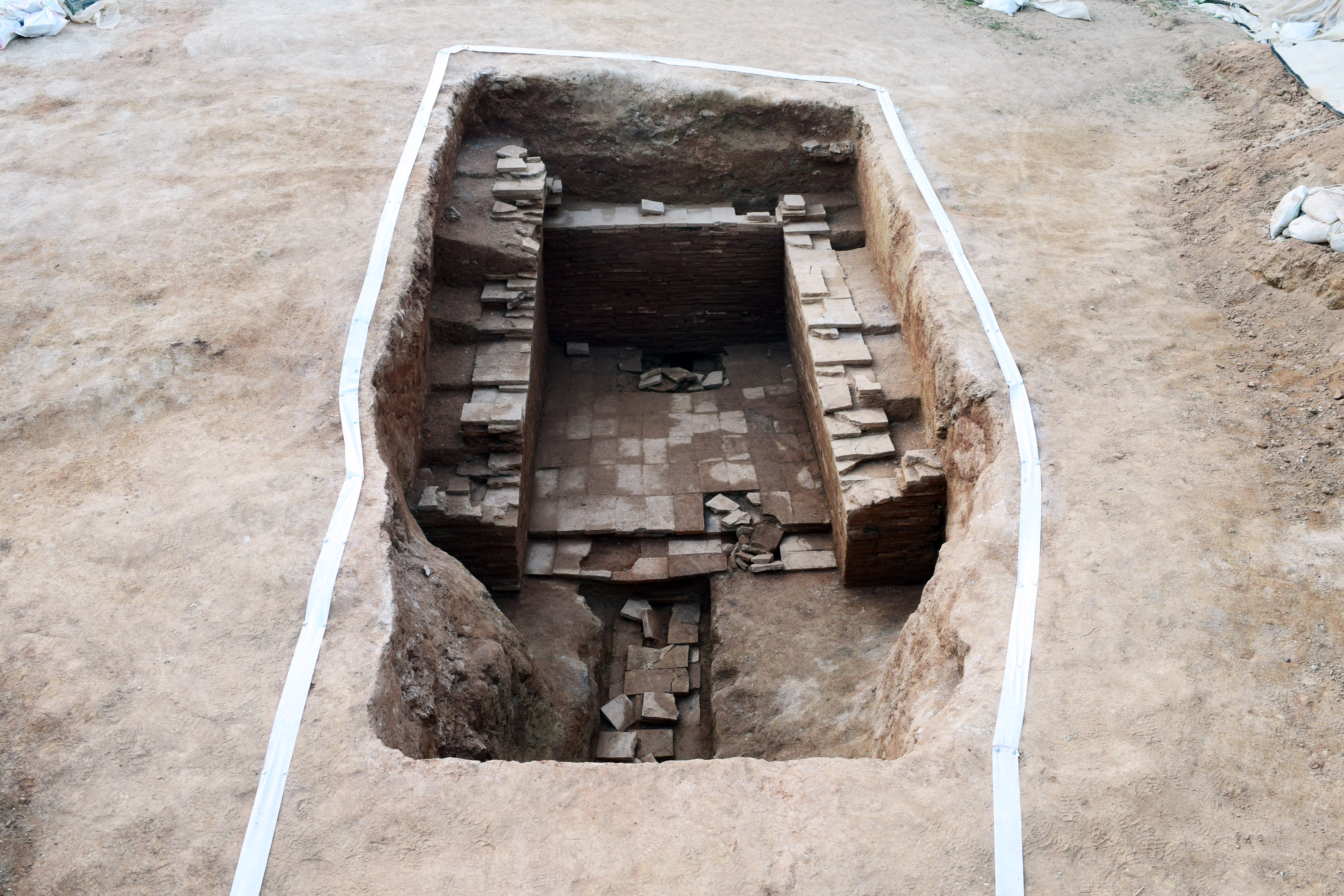
Gongju Gyochon-ri Brick Tomb, Preceded by the Tomb of King Muryeong
- National Research Institute of Cultural Heritage Confirms Gongju Gyochon-ri Brick Tomb Was Constructed Before the Late 4th Century Through Brick Dating
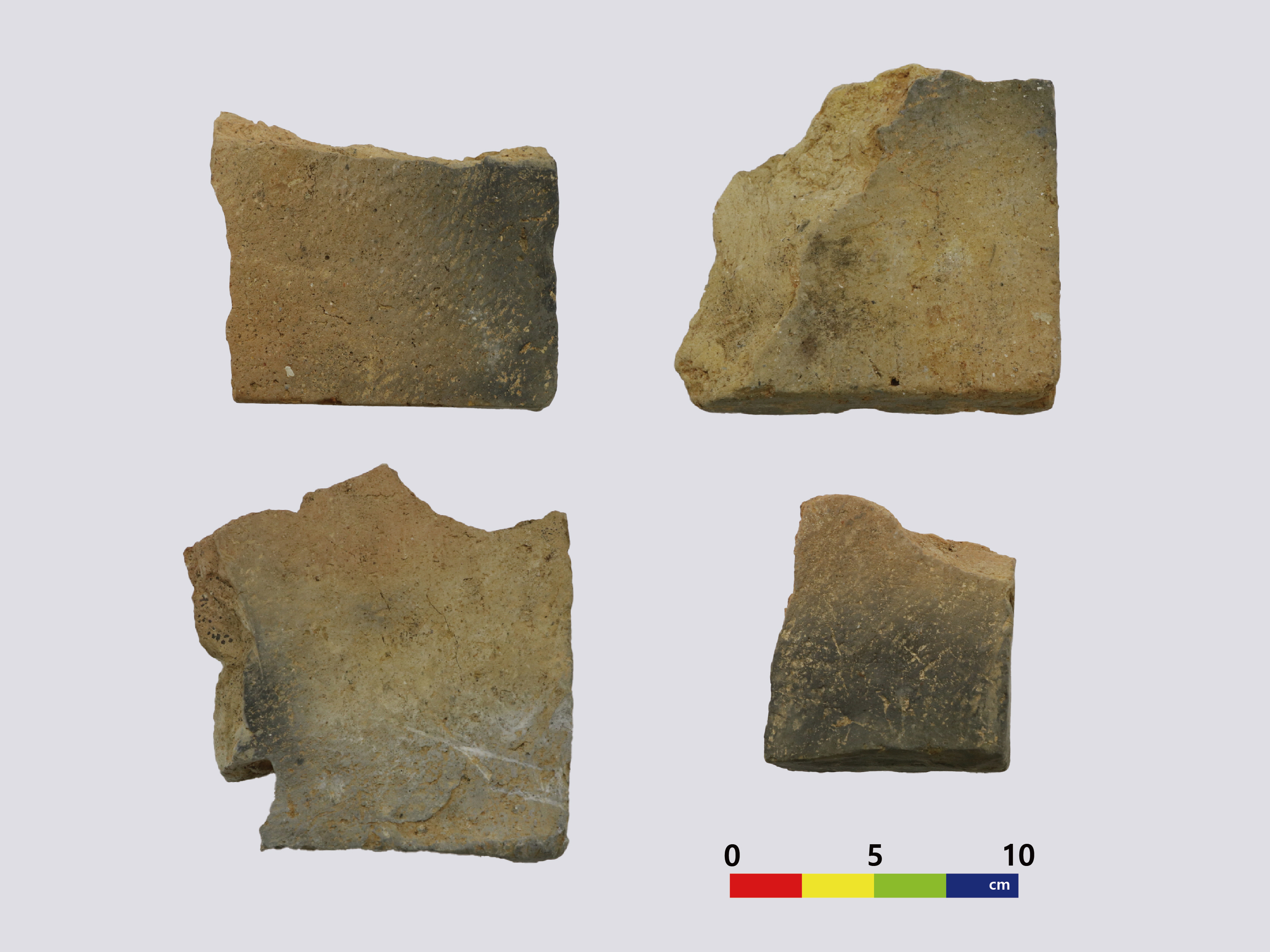
The National Research Institute of Cultural Heritage (Director Lim Jong-deok) of the National Heritage Administration revealed, through Optically Stimulated Luminescence (OSL) dating of the bricks, that the Gongju Gyochon-ri Brick Tomb (Gyochon-ri Antechamber Tomb No. 3) was constructed before the Tomb of King Muryeong.
* Optically Stimulated Luminescence (OSL) Dating: A technique for dating inorganic materials (sedimentary soil, kiln sites, pottery, roof tiles, bricks, etc.) using signals (luminescence) generated when quartz or feldspar is exposed to light.
The Gongju Gyochon-ri Brick Tomb (located at 252-1 Gyodong, Gongju-si, Chungcheongnam-do) is a tomb with an internal structure built like a room using bricks. This is a type of ancient tomb rarely found in Korea, and it includes the Tomb of King Muryeong in Gongju and Tomb No. 6 at the Royal Tomb Complex.
The Gyochon-ri brick tomb was already known during the Joseon Dynasty through a record in the section on Gongju-mok in the *Sinjeung Dongguk Yeoji Seungnam* (Revised and Expanded Geographical Survey of Korea), compiled in 1530 (the 25th year of King Jungjong's reign), which stated, "There is a tomb to the west of the Hyanggyo, which is said to be a royal tomb of Baekje."
During the Japanese colonial period in 1939, it was investigated by Karube Jion and Saito Tadashi. Subsequently, in 2018, the Gongju National University Museum conducted a re-excavation survey, confirming the tomb's structure and construction techniques. The Gongju Gyochon-ri Brick Tomb was constructed using bricks fired at relatively low temperatures and lacking patterns, and clay was used for the joints between the bricks.
However, no artifacts or inscriptions indicating a specific date have been identified, and it appears to exhibit different forms and material characteristics compared to the Tomb of King Muryeong and Tomb No. 6.
On the other hand, based on the excavated inscriptions, it can be inferred that the Tomb of King Muryeong and Tomb No. 6 were constructed under the technological influence of the Southern Dynasties of China.
* The inscription on the side of a brick excavated from Tomb No. 6 is interpreted as ‘Yanggwanwawisa-ui’ or ‘Yangseon-iwisa-ui.’ The ‘Yang’ indicated in the inscription can be interpreted as the Liang Dynasty of China (502–557). Furthermore, an inscription was confirmed on the sealing brick of Tomb No. 29, which was recently re-examined by the National Research Institute of Cultural Heritage in Buyeo, and it has been deciphered as ‘Jochasi Geonyeopinya’ (造此是建業人也). Interpreted as ‘The person who made this is a person from Geonye (Nanjing)’, this suggests that Southern Dynasties technicians participated in the production of the bricks and the tomb, considering that Nanjing in China was the capital of the Southern Dynasties at the time.
In particular, since the Tomb of King Muryeong has been presumed to have been constructed around the year Imjin (512), corresponding to King Muryeong’s reign (501–523), based on the inscription ‘~Saimjinnyeonjak’ (~士壬辰年作) engraved on the sealing brick, questions remained regarding whether the brick tomb in Gongju Gyochon-ri was constructed before the Tomb of King Muryeong or afterward using Baekje technology.
Accordingly, the National Research Institute of Cultural Heritage conducted radiocarbon dating on the bricks of the Gyochon-ri Brick Tomb, revealing that they were produced prior to the late 4th century.
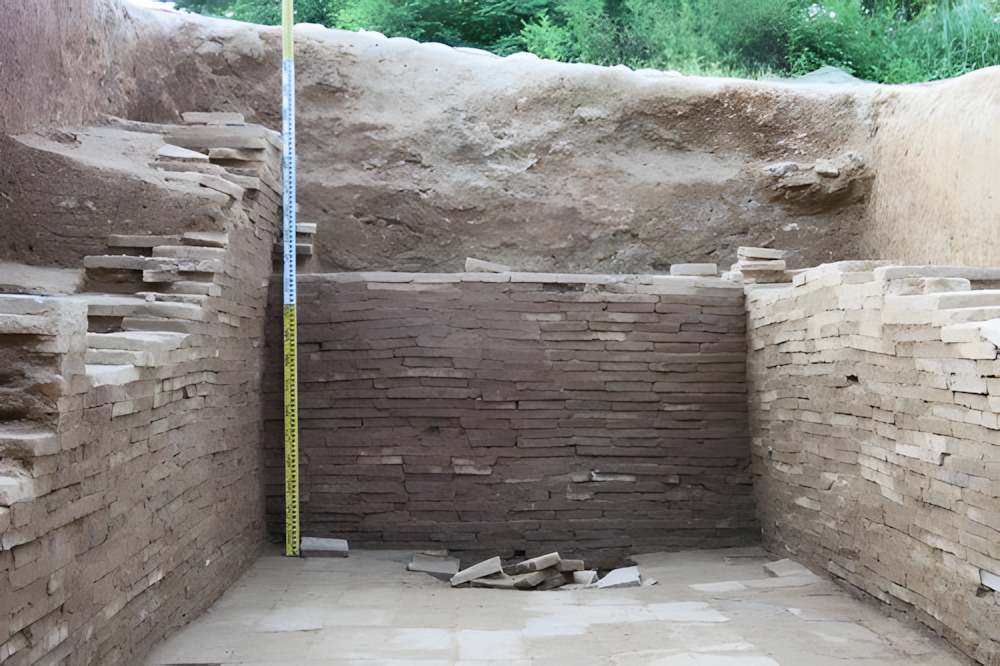
In other words, it can be estimated that the Gyochon-ri Brick Tomb was constructed more than a hundred years earlier than the Tomb of King Muryeong. Furthermore, it is possible to infer that the form of ancient tombs featuring a room-like internal structure made of bricks was first produced in this region during that period.
The scientific analysis methods and interpretation of the results of this dating will be presented at the ‘2026 Spring Joint Conference on Geological Science and Technology,’ to be held in Gangneung from April 21 to 24.
The National Research Institute of Cultural Heritage under the National Heritage Administration is promoting research on the dating of cultural heritage by establishing radiocarbon dating and optically stimulated luminescence dating systems.
It plans to continuously share related research findings with the public through more precise dating studies.
'NEWS & THESIS' 카테고리의 다른 글
| 우간다 파이톤 동굴에서 마버그 바이러스Marburg virus 발병 경로를 밝혀내다 (0) | 2026.04.22 |
|---|---|
| 탄소연대가 폭로한 모헨조다로 시작은 BC 3,300, 이집트 메소포타미아와 어깨 나란히? (0) | 2026.04.21 |
| 무령왕릉보다 100년 이상 앞서 만든 공주 교촌리 벽돌무덤[국립문화유산연구원 보도자료] (0) | 2026.04.21 |
| 영국 북부서 신석기 시대 수정 대량 발견, 불량품은 일부러 묻어 (0) | 2026.04.21 |
| 모헨조다로 최근 발굴은 어찌 봐야 하는가? (0) | 2026.04.21 |


댓글